Ice Cube Speaks Out: Why Oprah Kept Him Off Her Show and the Hollywood Gatekeeping Issue
Introduction In a recent interview, legendary rapper, actor, and entrepreneur Ice Cube made waves by revealing that he had been deliberately excluded from Oprah Winfrey’s show and other major platforms. His remarks have sparked a larger conversation about gatekeeping in Hollywood and the entertainment industry’s alleged bias against independent thinkers. Cube’s candid statements have left many questioning the hidden power structures within the media world.
Ice Cube’s Exclusion from Major Platforms During an interview with Tucker Carlson, Ice Cube disclosed that he had attempted to appear on The View multiple times, only to be rejected. According to him, the producers cited disagreements with his opinions as the reason for his exclusion. Similarly, he noted that despite starring in and producing successful films and television shows, he was never invited onto Oprah Winfrey’s show. Specifically, he mentioned that when his film Barbershop was being promoted, he was left out of the cast’s appearance on Oprah’s platform. He also recalled that for his TV show Black White, the entire cast was invited—except him.

These exclusions, he believes, are not random but part of a broader pattern of silencing voices that challenge mainstream narratives.
The Hollywood Gatekeeping Controversy Ice Cube has long spoken about the existence of a so-called “club” in Hollywood—an elite group of insiders who control access to major media platforms. He believes that those who do not align with a particular political or social ideology are deliberately sidelined. “I’m not part of the club,” Cube stated emphatically. “And a lot of you listening to me right now—you’re not part of the club either.”
He asserts that those who refuse to conform to industry norms face professional roadblocks, regardless of their talent or success. This kind of gatekeeping, he argues, has created a culture where only those who toe the line are given opportunities, while independent thinkers are ostracized.
The Politics of Exclusion Ice Cube has been vocal about his refusal to be politically categorized, and he has often expressed views that diverge from the expectations of Hollywood elites. He believes that his willingness to engage with all sides of the political spectrum has contributed to his exclusion. His appearances on platforms hosted by Tucker Carlson, Joe Rogan, and Piers Morgan have been met with criticism from certain media figures who see such engagements as controversial.
However, Cube insists that he is simply exercising his right to free speech and engaging in open dialogue. “They don’t like that I’m an independent thinker,” he said. “I’m not part of the herd.” His stance has resonated with many who feel that Hollywood and mainstream media have become increasingly polarized, stifling diverse perspectives in favor of a singular narrative.
The Impact of the “Contract with Black America” Cube also referenced the backlash he received after introducing the “Contract with Black America,” an initiative aimed at addressing systemic issues affecting Black communities. He noted that ever since he proposed this plan, certain forces in the industry have treated him differently. Despite this, he remains committed to advocating for real change rather than simply aligning with a particular political agenda.
Challenges with the NBA and Mainstream Media Beyond the entertainment industry, Ice Cube also discussed the struggles he has faced with his basketball league, the Big3. He claims that major sports organizations, including the NBA, have actively worked against his efforts to establish the league as a legitimate competitor. “What I want them to do when I say ‘work with us’ is to stop working against us,” he clarified. He believes that the NBA’s reluctance to support the Big3 is another example of the kind of industry-wide suppression that keeps independent ventures from thriving.
Similarly, he accused mainstream media of ignoring his projects and achievements, reinforcing his argument that a powerful group of insiders controls who gets visibility and who doesn’t.
The Gatekeepers Podcast Tour In response to these challenges, Ice Cube has announced his Gatekeepers Podcast Tour, an initiative designed to bypass traditional media structures and speak directly to the people. The tour will see him appearing on various independent platforms to discuss his views on Hollywood, media bias, and industry manipulation.
Cube is determined to spread his message regardless of pushback. “I’m going to talk to everybody,” he said. “Some people may get pissed off because I’m going to talk to everyone, but I don’t care.” He believes that open conversations—regardless of political affiliations—are necessary to break the stranglehold of mainstream media gatekeeping.
The Bigger Picture: What This Means for Hollywood and Free Speech Ice Cube’s revelations have reignited discussions about Hollywood’s power dynamics and the suppression of independent thought. His experiences highlight broader concerns about censorship, political bias, and the lack of diversity in perspectives within mainstream media.
For years, many have suspected that the entertainment industry operates within an echo chamber, rewarding those who conform and silencing those who don’t. Ice Cube’s willingness to challenge this system has made him both a target and a hero, depending on who you ask. Regardless of where one stands on the political spectrum, his stance raises important questions about the true nature of free speech in entertainment.
Conclusion Ice Cube’s claims about Oprah Winfrey and other media platforms may be controversial, but they shine a light on a much larger issue—the existence of an exclusive media club that determines who gets a voice. His refusal to conform and his push for independent dialogue represent a challenge to Hollywood’s status quo.
As he embarks on his Gatekeepers Podcast Tour, Cube remains steadfast in his mission to expose what he sees as industry manipulation and advocate for greater transparency. Whether one agrees with his views or not, his courage in standing up against powerful forces is undeniable. His story serves as a reminder that in the fight for free speech and independent thought, the battle is far from over.
News
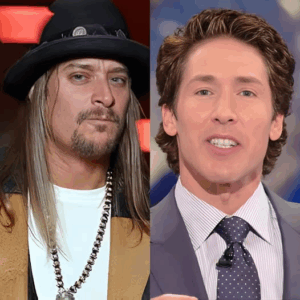
The auditorium glitched into silence the moment Joel Osteen leaned toward the mic and delivered a line no pastor is supposed to say in public. Even the stage lights seemed to hesitate as his voice echoed out: “God will NEVER forgive you.” People froze mid-applause. Kid Rock’s head snapped up. And in that weird, suspended moment, the crowd realized something had just detonated off-script.
The crowd expected an inspiring evening of testimony, music, and conversation. What they got instead was one of the most explosive on-stage confrontations ever witnessed inside a church auditorium. It happened fast—36 seconds, to be exact.But those 36 seconds would…
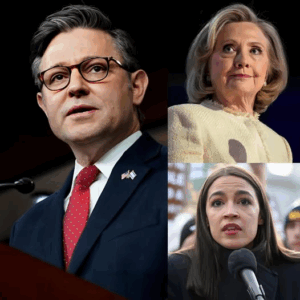
The room stalled mid-breath the moment Mike Johnson snapped open a black folder that wasn’t on any official docket. Cameras zoomed. Staffers froze. The label on the cover — CLINTON: THE SERVER SAGA — hit like a siren. Johnson leaned toward the mic, voice sharpened enough to scratch glass, and read a line that made every timeline jolt: “Her email is criminal.”
Here’s the thing about made-for-TV government: it knows exactly when to hold a beat. Tuesday’s oversight hearing had the rhythm down cold—routine questioning, polite skirmishes, staffers passing notes like we’re all pretending this is not a stage. And then Mike…

🔥 “THE FLOOR SHOOK BEFORE ANYONE COULD SPEAK.” — Investigator Dane Bonaro didn’t walk into the chamber — he tore through it, slamming a blood-red binder onto the desk with a force that made the microphones hiss. The label on the cover froze the room mid-breath: “1.4 MILLION SHADOW BALLOTS.” He locked eyes with the council and snarled, “You want the truth? Start with this.” For one suspended second, every camera operator lifted their lens like they’d just smelled a political explosion.
Here’s a scene you’ve watched a hundred times if you’ve spent enough hours in hearing rooms and greenrooms: a witness with a flair for performance, a committee hungry for a moment, and a gallery of reporters quietly betting which line…

🔥 “THE SMILE FLICKERED—AND THE ENTIRE STUDIO FELT IT.” — Laura Jarrett walked onto the Saturday TODAY set with the kind of calm, polished glow producers dream of. Cameras glided, lights warmed, and the energy felt like a coronation. But right as she settled between Peter Alexander and Joe Fryer, something shifted — a tiny hesitation in her smile, the kind that makes everyone watching sit up a little straighter. And then it came: a voice from outside the studio, sharp enough to snap the broadcast in half. For a full second, no one moved.
Here’s the thing about TV milestones: they’re designed for easy applause. A new co-anchor takes the desk, the chyron beams, the studio lights do their soft-shoe, and everyone is on their best behavior. It’s a ritual as old as morning-show…

🔥 “THE ROOM STOPPED LIKE SOMEONE CUT THE OXYGEN.” — What’s racing across timelines right now isn’t framed as a speech, or an interview, or even a moment. It’s being told like a rupture — the instant Erika Kirk, normally armored in composure, let a single tear fall while standing beside Elon Musk. Witnesses in these viral retellings swear the tear didn’t look emotional… it looked inevitable, like something finally broke through her defenses. And when Musk turned toward her, the entire audience leaned in as if they already knew the world was about to shift.
It was billed as a calm forum on human rights—an hour for big ideas like freedom, transparency, and the obligations that come with having a public voice. The stage was washed in soft gold, the kind of lighting that flatters…
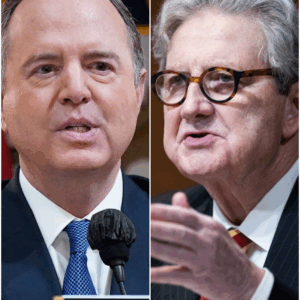
🔥 “THE ROOM WENT DEAD IN UNDER A SECOND.” — What unfolded inside the Senate chamber didn’t look like a hearing anymore — it looked like a trap snapping shut. Adam Schiff sat back with that confident half-smile, clutching a 2021 DOJ memo like it was the final move in a game he thought he’d already won. Staffers say he timed his line perfectly — “Your rhetoric ignores the facts, Senator. Time to face reality.” But instead of rattling Kennedy, something in the senator’s expression made even reporters lean forward, sensing the shift before anyone spoke again.
It didn’t look like much at first—another oversight hearing, another afternoon in a Senate chamber where the oxygen gets thinned out by procedure. Then Adam Schiff leaned into a microphone with a lawyer’s confidence, and John Neely Kennedy pulled out…
End of content
No more pages to load