Lauryn Hill: The Rise, Fall, and Industry Blacklisting of a Musical Icon
Lauryn Hill was once at the pinnacle of the music industry. With five Grammy Awards, millions of albums sold, and an undeniable cultural impact, she had the world at her feet. But then, she disappeared. The question remains: Did Lauryn Hill walk away from fame, or was she forced out by an industry that couldn’t control her?
The Making of a Star
Born on May 26, 1975, in South Orange, New Jersey, Lauryn Hill was raised in a musically inclined household. Her father, a computer consultant, sang at weddings and local events, while her mother was an English teacher. Music was always around her, influencing her love for various genres, from gospel to soul.

Even as a child, Hill was determined and competitive. She excelled in school, ran track, and took violin lessons, but it was her voice that truly set her apart. Her early foray into entertainment came through acting. She made TV appearances in As the World Turns and performed at Amateur Night at the Apollo Theater when she was just 13. However, her most notable acting role was in Sister Act 2: Back in the Habit (1993), where she played Rita Louise Watson. Her powerful performance in the film, particularly her rendition of Joyful, Joyful, left audiences in awe.
Despite her Hollywood prospects, Hill was more interested in music. She joined forces with Wyclef Jean and Pras Michel to form the Fugees, a group that would redefine hip-hop. Their debut album, Blunted on Reality (1994), went largely unnoticed, but their second album, The Score (1996), was a game-changer. With its blend of hip-hop, Caribbean, and soul influences, the album sold over 22 million copies worldwide. Hill’s hauntingly beautiful rendition of Killing Me Softly became an instant classic, making her the breakout star of the group.
Solo Stardom and Industry Pressure
By the late 1990s, tensions within the Fugees were growing. Hill’s relationship with Wyclef Jean had become complicated, leading to emotional and professional strains. When she became pregnant with Rohan Marley’s child, it marked the breaking point for the group. Hill was at a crossroads: remain in the Fugees or embark on a solo career where she could have full creative control. She chose the latter.
In 1998, she released The Miseducation of Lauryn Hill, an album that changed the landscape of music. Blending hip-hop, R&B, soul, and reggae, the album was deeply personal yet universally relatable. It debuted at No. 1 on the Billboard 200, selling over 10 million copies in the U.S. alone. Hill made history at the 1999 Grammy Awards, winning five awards in one night—the first woman to achieve such a feat.
However, despite her massive success, Hill was already feeling the weight of the industry. She spoke openly about the suffocating nature of fame, the manipulation of artists, and the pressure to conform. Unlike many musicians who sought validation from record labels, Hill valued artistic integrity and spiritual fulfillment over commercial success.
The Lawsuit and Industry Turn Against Her
Hill’s battle with the industry took a sharp turn in 1998 when four musicians—Vada Nobles, Rasheem Pugh, Johari Newton, and Tejumold Newton—filed a lawsuit against her. They claimed they had significantly contributed to The Miseducation of Lauryn Hill but were neither properly credited nor compensated. While many artists work with collaborators, Hill’s situation was painted differently. The lawsuit fueled speculation about whether she had written the songs herself, tarnishing her credibility as an artist.
In 2001, Hill settled the lawsuit for a reported $5 million. However, the damage had already been done. The industry, once eager to praise her, now viewed her as difficult and ungrateful. She became labeled as a diva, a narrative the media latched onto. Concert cancellations, erratic public appearances, and rumors of instability only added to the controversy.
The Tax Evasion Case and Further Isolation
As if the industry’s blacklisting wasn’t enough, Hill faced another major obstacle: a tax evasion case. In 2012, she pleaded guilty to failing to pay taxes on $1.8 million in earnings from 2005 to 2007. She was sentenced to three months in prison, followed by three months of house arrest. Many saw this as another way the system sought to punish her for refusing to conform.
Hill later explained that she had withdrawn from the industry to protect her family from its toxicity. She stated that she hadn’t paid taxes because she had removed herself from the public eye to ensure her well-being and that of her children. However, the courts showed little leniency, and she served her sentence.
Was Lauryn Hill Blacklisted?
Many believe that Hill was systematically blacklisted for refusing to play by the industry’s rules. Unlike other artists who embraced the fame machine, Hill spoke out against the exploitation and manipulation within the music business. She resisted the industry’s demands, refused to be controlled, and, as a result, was pushed out.
While some argue that Hill’s struggles were self-inflicted, others see her story as a cautionary tale about what happens when an artist refuses to conform. The same industry that celebrated her brilliance was quick to tear her down when she challenged its structure. In an industry dominated by men, Hill’s refusal to be molded into an industry puppet made her a threat.
A Legacy That Lives On
Despite the setbacks, Hill remains an influential figure in music. The Miseducation of Lauryn Hill continues to be regarded as one of the greatest albums of all time, inspiring artists across generations. Even though she has not released a follow-up studio album, her impact is undeniable. Her music, filled with wisdom, vulnerability, and social consciousness, remains relevant.
Hill occasionally resurfaces for performances, but she has never returned to the mainstream spotlight. Some fans remain hopeful for new music, while others respect her decision to stay out of an industry she once called corrupt.
Lauryn Hill’s story is one of artistic brilliance, resilience, and defiance. Whether she was blacklisted or simply chose to walk away, one thing is clear: she left an indelible mark on music and culture. Her legacy continues to shine, proving that true artistry transcends industry politics. In the end, Hill may have lost the battle with the industry, but she won the war for artistic integrity.
News
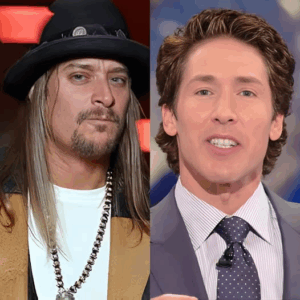
The auditorium glitched into silence the moment Joel Osteen leaned toward the mic and delivered a line no pastor is supposed to say in public. Even the stage lights seemed to hesitate as his voice echoed out: “God will NEVER forgive you.” People froze mid-applause. Kid Rock’s head snapped up. And in that weird, suspended moment, the crowd realized something had just detonated off-script.
The crowd expected an inspiring evening of testimony, music, and conversation. What they got instead was one of the most explosive on-stage confrontations ever witnessed inside a church auditorium. It happened fast—36 seconds, to be exact.But those 36 seconds would…

The room stalled mid-breath the moment Mike Johnson snapped open a black folder that wasn’t on any official docket. Cameras zoomed. Staffers froze. The label on the cover — CLINTON: THE SERVER SAGA — hit like a siren. Johnson leaned toward the mic, voice sharpened enough to scratch glass, and read a line that made every timeline jolt: “Her email is criminal.”
Here’s the thing about made-for-TV government: it knows exactly when to hold a beat. Tuesday’s oversight hearing had the rhythm down cold—routine questioning, polite skirmishes, staffers passing notes like we’re all pretending this is not a stage. And then Mike…

🔥 “THE FLOOR SHOOK BEFORE ANYONE COULD SPEAK.” — Investigator Dane Bonaro didn’t walk into the chamber — he tore through it, slamming a blood-red binder onto the desk with a force that made the microphones hiss. The label on the cover froze the room mid-breath: “1.4 MILLION SHADOW BALLOTS.” He locked eyes with the council and snarled, “You want the truth? Start with this.” For one suspended second, every camera operator lifted their lens like they’d just smelled a political explosion.
Here’s a scene you’ve watched a hundred times if you’ve spent enough hours in hearing rooms and greenrooms: a witness with a flair for performance, a committee hungry for a moment, and a gallery of reporters quietly betting which line…

🔥 “THE SMILE FLICKERED—AND THE ENTIRE STUDIO FELT IT.” — Laura Jarrett walked onto the Saturday TODAY set with the kind of calm, polished glow producers dream of. Cameras glided, lights warmed, and the energy felt like a coronation. But right as she settled between Peter Alexander and Joe Fryer, something shifted — a tiny hesitation in her smile, the kind that makes everyone watching sit up a little straighter. And then it came: a voice from outside the studio, sharp enough to snap the broadcast in half. For a full second, no one moved.
Here’s the thing about TV milestones: they’re designed for easy applause. A new co-anchor takes the desk, the chyron beams, the studio lights do their soft-shoe, and everyone is on their best behavior. It’s a ritual as old as morning-show…
🔥 “THE ROOM STOPPED LIKE SOMEONE CUT THE OXYGEN.” — What’s racing across timelines right now isn’t framed as a speech, or an interview, or even a moment. It’s being told like a rupture — the instant Erika Kirk, normally armored in composure, let a single tear fall while standing beside Elon Musk. Witnesses in these viral retellings swear the tear didn’t look emotional… it looked inevitable, like something finally broke through her defenses. And when Musk turned toward her, the entire audience leaned in as if they already knew the world was about to shift.
It was billed as a calm forum on human rights—an hour for big ideas like freedom, transparency, and the obligations that come with having a public voice. The stage was washed in soft gold, the kind of lighting that flatters…

🔥 “THE ROOM WENT DEAD IN UNDER A SECOND.” — What unfolded inside the Senate chamber didn’t look like a hearing anymore — it looked like a trap snapping shut. Adam Schiff sat back with that confident half-smile, clutching a 2021 DOJ memo like it was the final move in a game he thought he’d already won. Staffers say he timed his line perfectly — “Your rhetoric ignores the facts, Senator. Time to face reality.” But instead of rattling Kennedy, something in the senator’s expression made even reporters lean forward, sensing the shift before anyone spoke again.
It didn’t look like much at first—another oversight hearing, another afternoon in a Senate chamber where the oxygen gets thinned out by procedure. Then Adam Schiff leaned into a microphone with a lawyer’s confidence, and John Neely Kennedy pulled out…
End of content
No more pages to load